Followers

Total Pageviews

Sunday, October 8, 2017

Champaner Series | Shaher ki Masjid | Part 2


After the topsy turvy ride from Vadodara station to Champaner I was all set to explore the treasures of the past.(To know about the Champaner and my interesting journey click on this link Champaner Series- The journey-part 1


Entry Gate

It was 8 am when I reached the gates of Champaner world heritage site. My joys were dampen when I saw huge crowd of people at the gate, blowing those crazy horns, donning goggles and taking selfies,for a second I thought coming in navaratris was a bad idea specially with Pavagadh Kalkaji temple just opposite this site.

Lekin ab aaye hu toh dekh kar toh pakka jaunga

The gate through which  I entered the site is known as South Bhadra Gate. 

Plaque outside the Entry Gate

Passage


I walked through a passage with a big partition wall and then came across a huge second gate.

Huge second gate

When I entered this gate I saw the fortification wall on the left.


Fortification wall

 Actually this fortification wall runs around this Champaner site and the two mosques Shaher ki Masjid and Jami Masjid lies within this complex.The other three mosques i.e Brick Masjid , Kevada Masjid and Nagina Masjid on the outer side of the fortification wall.


One can see the Fortification wall in the picture

Moving towards the right side I come across a beautiful mosque Saher ki Masjid. Just outside the mosque there is this small ticket office where I paid Rs 30 as entry fee,I was informed by the office bearer that I have to retain the ticket after visiting this Masjid as the same ticket has to be shown at the entry point of Jami Masjid also. 


Beautiful Shaher Ki Masjid


Shaher ki Masjid, if literally translated means " Mosque of the city". Basically it's a private mosque built for the royal family and nobles of Gujarat Sultanate during 15-16 Century.


Mix of Indian and Islamic Architechure

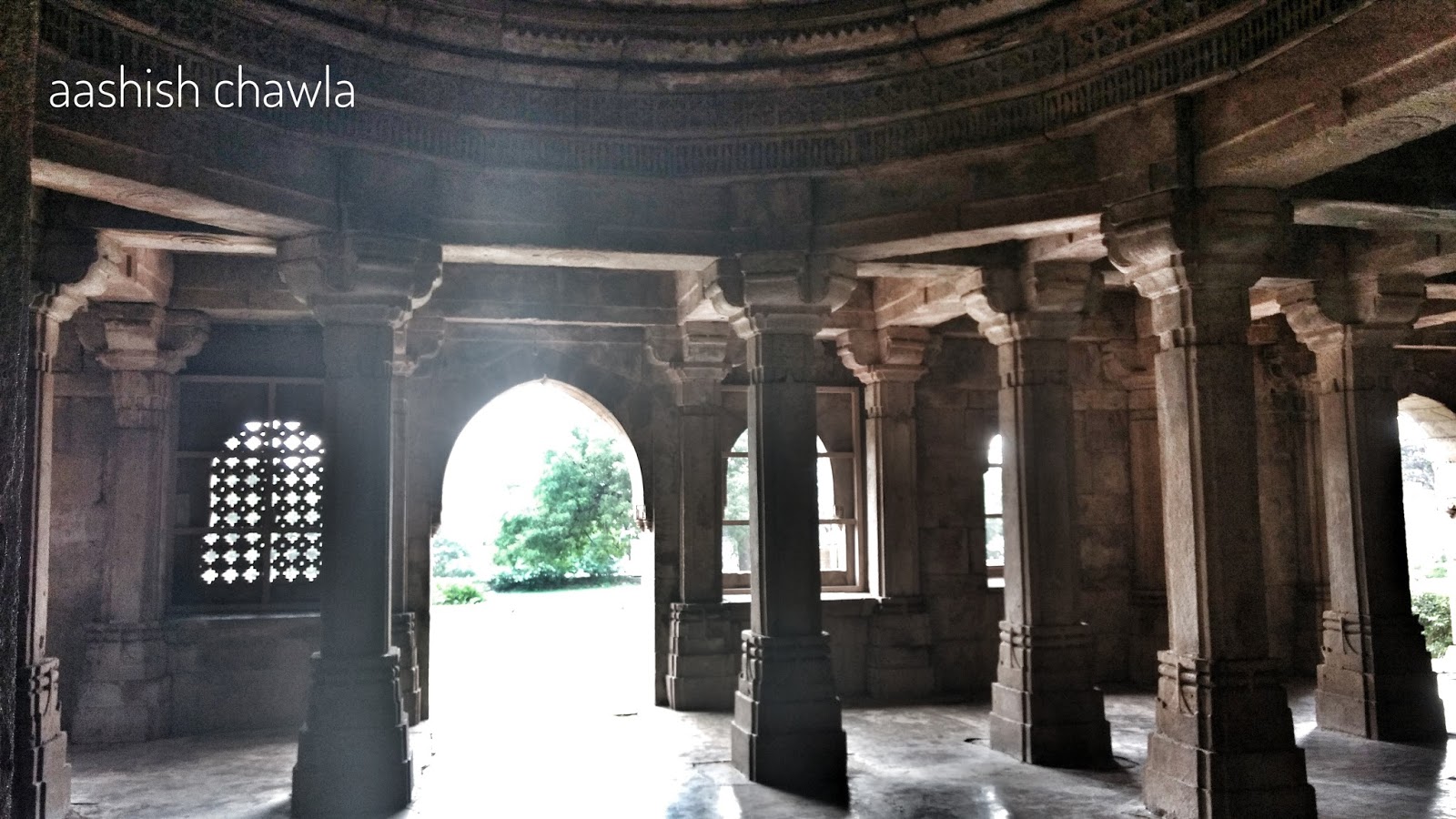
Talking of the architectural aspects of this masjid, it's a mix of Indian trabeate consisting of pillars and beams and Islamic arcuate consisting of columns and arch.


Me standing on the raised platform
on which this mosque is built.


This Masjid is constructed on a raised platform.with well maintained lawn in front of the mosque. ASI has done the good job of maintaining this heritage.

 The Mosque has a large prayer hall admeasuring 56x40 metres.


Large Prayer Hall

This prayer hall has five Mirhabs and can be accessed through a central arched entrance flanked by two minarets on both sides.


Two Minarets


Central gate 

In addition to this there are two arched entrances on either side of the central one fringed by Jharokhas.

Jharokas next to the entrances


There are large domes on top corresponding to each arched entrance. The Minarets have some exquisite cravings which appears more hindu in nature than islamic. 


 Exquisite cravings
Absorbing the beautiful sight of this amazing mosque I moved on to explore the next gem Jami Masjid. Please stay tuned for my next blog on Iteri Masjid.(⇐ click here to read)


Thank You


Thursday, September 28, 2017

Champaner Series | The journey | part 1


This is how it began.....

It all started during my trip to Jodhpur (you can read from this link about my Jodhpur Series) last month, when a co passenger in the train dropped this name Champaner near vadodara, a sucker that I am for any new off beat destination I was kind of all ears to him. I could see the joy on his face as he was describing the place to me.

Sir this place was lost to people for more than 500 years !

You must see this wonderful confluence of Islamic, Hindu and Jain culture in the construction of these monuments and

above all this Champaner was declared as UNESCO world heritage site !

It was then and there I knew that I won't be able to sleep peacefully if I don't visit this place. Well I asked few of my friends if they could join me but every one  was busy , Friday night I decided that I'm going what may come , so I packed my backpack which consists of bare necessities and of course my love my camera and I was off to Mumbai central station to catch late night Vadodara Express which departs at 11.40 to Vadodara.

All set to go on a night train to Vadodara


Due to unreserved journey I had tough time managing to sleep and when I was all set to go to sleep Vadodara Station has arrived. It was 6:30 am when I reached Vadodara station. I quickly had khaman for breakfast at the station and then moved on to the Vadodara Central bus station which is very near to the Railway station. 


Vadodara Central Bus Station (Pic source internet)

Catching bus from ST stand are the real challenge, Though I enquired at the bus counter for the bus to Champaner I was told to take pavagadh bus from platform 16,  Upon reaching the bus  platform 16 when I saw the name pavagadh I asked the conductor whether this bus go to Champaner he said no, but you go from there to Champaner, so all confusion.


Platform no 16 at Vadodara Central Station( Pic source internet)


Just then I saw a Rajasthan roadway bus and people jumped from the bus in which I was sitting to the Rajasthan roadways bus going to pavagadh, I too jumped and got in it. When I asked for the ticket to Pavagadh ,the conductor told me that this bus will drop me to Halol and from there I'll have to take an auto or bus to Pavagadh. I was like Hey Bhagwan, Meri maddat karo. Anyways this journey to Halol lasted around an hour and luckily I found a bus going to Pavagadh from there. This time I didn't take a chance and kept the GPS On, on my phone and as soon as I read Champaner I told the bus guy to stop he said Arre saheb, Bus stand 1 min hi door hai . So I quitely sat down and indeed realised that the Pavagadh ST bus station is just opposite the Champaner World heritage.


Pavagadh ST bus Station( Pic source internet)


 See the irony that Vadodara station have this large poster in their waiting room and yet the locals are unaware of this treasure in their back yard.
Poster at Vadodara Waiting Room


At last this topsy turvy journey of mine came to an end and I was all set to step into the world of Ancient era of UNESCO World heritage site of Champaner. So what is this Champaner all about well here is little info you can use.

Champaner-Pavagadh Archaeological Park

It is a concentration of largely unexcavated archaeological, historic and living cultural heritage properties cradled in an impressive landscape which includes prehistoric (chalcolithic) sites, a hill fortress of an early Hindu capital, and remains of the 16th-century capital of the state of Gujarat. The site also includes, among other vestiges, fortifications, palaces, religious buildings, residential precincts, agricultural structures and water installations, from the 8th to 14th centuries. The Kalikamata Temple on top of Pavagadh Hill is considered to be an important shrine, attracting large numbers of pilgrims throughout the year. The site is the only complete and unchanged Islamic pre-Mughal city.

Justification for it been a World Heritage site

Criterion (iii): The Champaner-Pavagadh Archaeological Park with its ancient Hindu architecture, temples and special water retaining installations together with its religious, military and agricultural structures, dating back to the regional Capital City built by Mehmud Begda in the 16th century, represents cultures which have disappeared.

Criterion (iv): The structures represent a perfect blend of Hindu-Moslem architecture, mainly in the Great Mosque (Jami Masjid), which was a model for later mosque architecture in India. This special style comes from the significant period of regional sultanates.


Criterion (v): The Champaner-Pavagadh Archaeological Park is an outstanding example of a very short living Capital, making the best use of its setting, topography and natural features. It is quite vulnerable due to abandonment, forest takeover and modern life.


Criterion (vi): The Champaner-Pavagadh Archaeological Park  place of worship and continuous pilgrimage for Hindu believers.

 Aren't you excited like me to know the history and explore the grandeur of the past era consisting of some of the amazing Mosques,Jain Temples and cenotaphs.

Well then stay tuned till my next blog on amazing Shaher ki Masjid.


Thank you


Friday, September 22, 2017

Jodhpur Dairies| Mehrangarh Fort-Gates | Part 3


Mehrangarh Fort :

We had just finished exploring Sardar Market and Toorji ka Jalra ( Click here if you want to read the earlier post) , we  were so excited discussing the architectural marvel of  Toorji ka Jalra and as how animals and human roam commonly at Sardar Market. 


Toorji Ka Jalra -The stepwells

We were now gearing up to go to our next destination, which was Mehrangarh Fort. We again turned to the locals for guidance and were happy to know that Mehrangarh fort is not too far from Toorji ka Jalra so we again started walking through the narrow alleys of Jodhpur

Narrow alleys of Jodhpur


However we soon realised though Mehrangarh fort is near but the climb was very steep. As we are trekker so for us it was not much of a task. The climb from the town to the top took us around 15-20 minutes, but the steepness of the climb and the satiating heat ensured that we gulped down at least one litre water. 
Uff Rajasthan ki Garmi !!!


The steep climb to the Fort

The route we took to reach Mehrangarh is basically a pedestrian route, actually there is another route on which the vehicles ply.This we realised when we reached the entrance of the Mehrangad fort where  there was a huge parking lot with tourist buses and taxis. Standing here one realise how huge the fort is.


The tall standing Fort

Mehrangad ....Naam hi kafi Hai

And why do I say this,well as soon as you get down from the train at Jodhpur Station,one thing that you cannot miss is this gigantic fort lording over the Jodhpur city. Perched on a Rocky Hill of more than 400 feet it sits like a crown. I'm told it's one of the largest fort of Rajasthan, it contains some of the finest palaces and its museum contains many priceless relics of golden times of Kings and queens.


Mehrangarh Fort

Well, back to our story, we sat for few minutes at the parking to catch our breath and gulped some more water. Now an important thing to note here is that the security guys don't allow any kind of eatables in your bags hence we had to deposit all of chips and other snacks at the counter. Dil ke armaan aanso me beh Gaye.... Kya Kya Socha Tha, Fort ki top per Jodhpur the blue city ko dekte hue we will munch this snacks...shh flop show ,but never mind chote chote shahero me aasi choti choti baate ho jati Hai. So obediently we deposited everything with the security guy and moved towards the ticket counter.


Security check just before the entrance

But before entering the first gate one cannot help noticing a beautiful chatri  of Thakur Chauhan Shyam Singh. Cradled at the base of the fort it offers beautiful sight and also give you the idea of the amazing sights to follow.This is actually a memorial for a brave soldier Thakur Chauhan Shyam Singh who fought brilliantly but lost his life defending the Mehrangad fort from Jaipur army.


Beautiful Chatri


Entry to the fort is gained though a series of seven gates.
The most famous of the gates are:

Jai Pol ("Gate of Victory"): 


Jai Pol

This gate was built by Maharaja Man Singh in 1806 to celebrate his victory in a war with Jaipur and Bikaner. As you enter through this gate you would be taken in by the exquisite painting adorning the flanks of the gate.

Exquisite painting on walls
next to the entrance door

After entering this entrance gate just on the left side is the Ticket counter, from where we bought the tickets and also paid for the guide, Ab yeh alag baat hai ki guide se jyada Google ne enlighten kiya tha. One can also get Audio Guide with Headphones from this ticket counter


Moving towards the next gate with
Palkikhana on right side.

Moving little ahead of the ticket counter we came across a small area know as Palkikhana, well this Palkikhana dates to late 19thcentury and it once housed  the luxurious Palanquins alias Palki that carried the Maharajas in Grand ceremonial processions and of course the beautiful royal ladies when they ventured out of their zenana Khana.

Palkikhana ( Now its a Food shop)
Dedh Kambra Gate:

Moving ahead of this we see another gate known as Dedh Kambra Gate. The significant thing about this gate is the bastion wall which has this holes or dent marks.


Which according to our guide was due to heavy shelling of cannon balls done by the then Jaipur army. However ever after all this the wall stood strong and the fort couldn't be won.

Cannon balls dent 
Story on the Wall

We walked through this gate only to come out in a section which had a canon on our right and the next gate on our left 


Cannon next to the gate 

and the gigantic fort looking upon us like some huge giant and we come across the next gate. Gate Fateh Pol.


Gigantic fort above us

Fateh Pol :  This gate was built to celebrate a victory over the Mughals in 1707.


View from Fateh Pol

Another noteworthy thing next to this gate was a small memorial. Our guide informed us that there is a tragic tale behind this.

 Raja Ram Meghwa memorial stone


 The legend goes that when Maharaja Rao Jodha encroached on the ashram of Cheeranathji, who got enraged and cursed that the kingdom will suffer the wrath of droughts. Though the Maharaja tried to pacify the hermit , but the damage was done and the curse couldn't be revoked, it's here that a local by the name Raja Ram Meghwal offered himself as human sacrifice to change the course of the curse then there was another local tale that the Raja Ram Meghwal was interred alive in the foundation of the fort....Uff kitna tension Tha...I felt sad but then these things happens to poor people.


Notice on the right Raja Ram Meghwal memorial and the changing colours of the fort stones

Our guide informed us that actually the original fort started from the point where we are standing, one can see the change in the stone colour white stone and then red stone. The subsequent kings made the new additions to the fort hence the different styling in the fort construction.


Different strokes of colour as we climb from here to next gate

Walking on a little steep climb further we come across another prominent gate but just before this gate you see local musicians playing different musical instruments giving the whole ambiance of Rajasthani touch. 


Rajasthani Music played by local musicians
Crossing over from here we come to the last main entrance known as Loha Pol or Iron Gate

Loha Pol :

This gate is known as Loha Pol or iron gate. There are many interesting things about this gate, the first being that this gate is on a turn which manages to slow down the attacking army, secondly being on the turn the elephants cannot get a start run to ram the doors


 and to further neutarise the attacks there are iron spikes on the doors which could very well injure the forehead of the raging elephants of enemies. How gruesome! But then that's how the wars were fought

Iron spikes on the doors


Loha Pol, in a way is the final gate into the main part of the fort complex. As soon as we enter through it we Immediately see on our left side  some interesting handprints and mind you these are not some vague representation of handprints, I was told these handprints are the final memories of the women who left the fort to be Sati.


Handprints  of the women
who left the fort to be Sati.


While the wall on the right had 5 handprints of the ranis who in 1843 immolated themselves on the funeral pyre of their husband, Maharaja Man Singh.


5 handprints of the Ranis

From here we finally enter the fort,on the left there is a long rampant wall which had cannons mounted on them and on the right side we enter into the world of palaces, palanquins and Houdahs. 


Are you not excited to know about them, well stay tuned for my next blog till then happy reading. Thank You !


Thursday, August 3, 2017

Jodhpur Diaries | Toorji Ka Jhalra | Part 2


After finishing the Sardar Market (Click here to read part 1) we came out from the gate opposite to the Nai Sarak gate. Immediately after coming out we inquired from the local shopkeeper as to where is Toorji ka Jhalra,

Back gate of Sardar Market


Luckily for us he knew to the place and directed us.You must be wondering as what is this Toorji ka Jhalra, Well Chalo aaj aap ki class leta hu, Please bore mat hona Stepwells in most part of India are known as bavri or bawdi but here in Jodhpur it's called Jhalra. Toorji ka Jhalra is an ancient stepwell. One can easily reach this place by simply inquiring from the locals.


Narrow streets with Blue houses


 A little walk through the narrow alleys,local blue houses and in hardly 10 mins you are at Toorji ka Jhalra Stepwell. Standing at the road level one cannot gauge as to what is in store for him or her unless one climb few steps and reach the edge of the stepwell. That is the reason I didn't divulge any information to any of my co travelers, I wanted to surprise them. Hence just like a magician who is ready to unveil the secret magical object , I called all of them to the edge and  then called out to open their eyes. I  got the response that I was seeking  from them and yes it was simply   WOW.

I could see the sparkle in their eyes. Who could have thought that such beautiful historical treasures lies in the narrow alleys of this Blue city. 


Wow Moment


Let me inform you Jodhpur is full of such hidden stepwells,some are explored while some lies buried due to neglect. I'm told there are more than 100 such hidden stepwells. According to Rajyavallabh and Prasad Mandan, two traditional books on town planning in Rajasthan, an ideal city should have 40 stepwells. Ab dekhna yeh tha ki Jodhpur me kitni milti hai dekne ko So for a start Toorji ka Jhalra was the first one to be visited by us.


All over India, stepwells are on the verge of extinction, barring a few big ones that have survived  the test of time are being turned into local tourist wonders. Jodhpur, however, has the unique distinction of not only maintaining these structures well, but also using the water for domestic and recreational purposes. In fact, the city’s stepwell system is an example of what can be achieved through people’s participation.


\Why I said people participation, Actually due to neglect these stepwells were buried underneath the heap of debris, waste, mud etc but then the local volunteer through community efforts cleared and cleaned these hidden treasures.


View at the bottom 


Folklore.

While talking to the local guide,he gave me an interesting insight to these stepwells. According to him there is a folklore about Jodhpur having a curse. In the mid 15th century, the king of Mandore , Rao Jodha, was keen on moving his capital to an elevated spot from where he could defend the empire against frequent attacks by enemies. He found Chidia-tunk, a 125m-high rocky hill, ideal for this. However, inorder to build Mehrangarh Fort, he had to  encroach upon the hermitage of Saint Chiriya Nathji, who in anger cursed that the new city would face  constant famines.In response to  the curse the king realised  that they will have to safeguard themselves against this curse, Hence  town planners thought of this water conservation tool of stepwells.


Mehrangad fort is on the hilltop, the walled city of Jodhpur is located at the foot of Chidia-tunk. This made it possible to supply water through a gravity-led system. A vast network of lakes and canals were built in the hills around the city, while wells, stepwells (bawri), step ponds (jhalara) and tanks became a common feature in the plains.


Intricate carvings around Windows


Those maze of steps , the carvings on the stone , for me these stepwells are nothing but architectural delights to be relished.

Fact File of Toorji ka Jhalra

Toorji ka Jhalra was built in the 1740s by Maharaja Abhay Singh's queen consort which was in keeping with the age old tradition of ladies of the royal family building Public water works. The Jhalra was primarily used by women, as fetching and storing water was one of their principal household chores.The Jhalra is embellished with intricate carving of dancing elephants, Medieval Lion and cow shaped water sprouts.


Some more carvings


I think enough of Gyan for today. We were running like mad up and down the stone stairs of this step well enjoying every nook and corner of this well.


Running up and down, exploring every nook and corner


The water below have lots of fishes in it.The depth of the stepwells was nothing less than 200 feets.


Its Show time for the Gang


We took few photos to mark our presence. I had to drag everyone out because our next destination Mehrangad fort was beckoning us.


Our Team

Popular Posts