Followers

Total Pageviews

Showing posts with label Hindu.architecture. Show all posts

Sunday, October 8, 2017

Champaner Series | Shaher ki Masjid | Part 2


After the topsy turvy ride from Vadodara station to Champaner I was all set to explore the treasures of the past.(To know about the Champaner and my interesting journey click on this link Champaner Series- The journey-part 1


Entry Gate

It was 8 am when I reached the gates of Champaner world heritage site. My joys were dampen when I saw huge crowd of people at the gate, blowing those crazy horns, donning goggles and taking selfies,for a second I thought coming in navaratris was a bad idea specially with Pavagadh Kalkaji temple just opposite this site.

Lekin ab aaye hu toh dekh kar toh pakka jaunga

The gate through which  I entered the site is known as South Bhadra Gate. 

Plaque outside the Entry Gate

Passage


I walked through a passage with a big partition wall and then came across a huge second gate.

Huge second gate

When I entered this gate I saw the fortification wall on the left.


Fortification wall

 Actually this fortification wall runs around this Champaner site and the two mosques Shaher ki Masjid and Jami Masjid lies within this complex.The other three mosques i.e Brick Masjid , Kevada Masjid and Nagina Masjid on the outer side of the fortification wall.


One can see the Fortification wall in the picture

Moving towards the right side I come across a beautiful mosque Saher ki Masjid. Just outside the mosque there is this small ticket office where I paid Rs 30 as entry fee,I was informed by the office bearer that I have to retain the ticket after visiting this Masjid as the same ticket has to be shown at the entry point of Jami Masjid also. 


Beautiful Shaher Ki Masjid


Shaher ki Masjid, if literally translated means " Mosque of the city". Basically it's a private mosque built for the royal family and nobles of Gujarat Sultanate during 15-16 Century.


Mix of Indian and Islamic Architechure

Talking of the architectural aspects of this masjid, it's a mix of Indian trabeate consisting of pillars and beams and Islamic arcuate consisting of columns and arch.


Me standing on the raised platform
on which this mosque is built.


This Masjid is constructed on a raised platform.with well maintained lawn in front of the mosque. ASI has done the good job of maintaining this heritage.

 The Mosque has a large prayer hall admeasuring 56x40 metres.


Large Prayer Hall

This prayer hall has five Mirhabs and can be accessed through a central arched entrance flanked by two minarets on both sides.


Two Minarets


Central gate 

In addition to this there are two arched entrances on either side of the central one fringed by Jharokhas.

Jharokas next to the entrances


There are large domes on top corresponding to each arched entrance. The Minarets have some exquisite cravings which appears more hindu in nature than islamic. 


 Exquisite cravings
Absorbing the beautiful sight of this amazing mosque I moved on to explore the next gem Jami Masjid. Please stay tuned for my next blog on Iteri Masjid.(⇐ click here to read)


Thank You


Thursday, September 28, 2017

Champaner Series | The journey | part 1


This is how it began.....

It all started during my trip to Jodhpur (you can read from this link about my Jodhpur Series) last month, when a co passenger in the train dropped this name Champaner near vadodara, a sucker that I am for any new off beat destination I was kind of all ears to him. I could see the joy on his face as he was describing the place to me.

Sir this place was lost to people for more than 500 years !

You must see this wonderful confluence of Islamic, Hindu and Jain culture in the construction of these monuments and

above all this Champaner was declared as UNESCO world heritage site !

It was then and there I knew that I won't be able to sleep peacefully if I don't visit this place. Well I asked few of my friends if they could join me but every one  was busy , Friday night I decided that I'm going what may come , so I packed my backpack which consists of bare necessities and of course my love my camera and I was off to Mumbai central station to catch late night Vadodara Express which departs at 11.40 to Vadodara.

All set to go on a night train to Vadodara


Due to unreserved journey I had tough time managing to sleep and when I was all set to go to sleep Vadodara Station has arrived. It was 6:30 am when I reached Vadodara station. I quickly had khaman for breakfast at the station and then moved on to the Vadodara Central bus station which is very near to the Railway station. 


Vadodara Central Bus Station (Pic source internet)

Catching bus from ST stand are the real challenge, Though I enquired at the bus counter for the bus to Champaner I was told to take pavagadh bus from platform 16,  Upon reaching the bus  platform 16 when I saw the name pavagadh I asked the conductor whether this bus go to Champaner he said no, but you go from there to Champaner, so all confusion.


Platform no 16 at Vadodara Central Station( Pic source internet)


Just then I saw a Rajasthan roadway bus and people jumped from the bus in which I was sitting to the Rajasthan roadways bus going to pavagadh, I too jumped and got in it. When I asked for the ticket to Pavagadh ,the conductor told me that this bus will drop me to Halol and from there I'll have to take an auto or bus to Pavagadh. I was like Hey Bhagwan, Meri maddat karo. Anyways this journey to Halol lasted around an hour and luckily I found a bus going to Pavagadh from there. This time I didn't take a chance and kept the GPS On, on my phone and as soon as I read Champaner I told the bus guy to stop he said Arre saheb, Bus stand 1 min hi door hai . So I quitely sat down and indeed realised that the Pavagadh ST bus station is just opposite the Champaner World heritage.


Pavagadh ST bus Station( Pic source internet)


 See the irony that Vadodara station have this large poster in their waiting room and yet the locals are unaware of this treasure in their back yard.
Poster at Vadodara Waiting Room


At last this topsy turvy journey of mine came to an end and I was all set to step into the world of Ancient era of UNESCO World heritage site of Champaner. So what is this Champaner all about well here is little info you can use.

Champaner-Pavagadh Archaeological Park

It is a concentration of largely unexcavated archaeological, historic and living cultural heritage properties cradled in an impressive landscape which includes prehistoric (chalcolithic) sites, a hill fortress of an early Hindu capital, and remains of the 16th-century capital of the state of Gujarat. The site also includes, among other vestiges, fortifications, palaces, religious buildings, residential precincts, agricultural structures and water installations, from the 8th to 14th centuries. The Kalikamata Temple on top of Pavagadh Hill is considered to be an important shrine, attracting large numbers of pilgrims throughout the year. The site is the only complete and unchanged Islamic pre-Mughal city.

Justification for it been a World Heritage site

Criterion (iii): The Champaner-Pavagadh Archaeological Park with its ancient Hindu architecture, temples and special water retaining installations together with its religious, military and agricultural structures, dating back to the regional Capital City built by Mehmud Begda in the 16th century, represents cultures which have disappeared.

Criterion (iv): The structures represent a perfect blend of Hindu-Moslem architecture, mainly in the Great Mosque (Jami Masjid), which was a model for later mosque architecture in India. This special style comes from the significant period of regional sultanates.


Criterion (v): The Champaner-Pavagadh Archaeological Park is an outstanding example of a very short living Capital, making the best use of its setting, topography and natural features. It is quite vulnerable due to abandonment, forest takeover and modern life.


Criterion (vi): The Champaner-Pavagadh Archaeological Park  place of worship and continuous pilgrimage for Hindu believers.

 Aren't you excited like me to know the history and explore the grandeur of the past era consisting of some of the amazing Mosques,Jain Temples and cenotaphs.

Well then stay tuned till my next blog on amazing Shaher ki Masjid.


Thank you


Friday, March 4, 2016

Fatehpur Sikri Series: Part 2


I was simply amazed as to how my time passed away strolling through the courtyards and corridors of this amazing Jodhabai Palace.( Click on this link to read the earlier Part 1) The place left me spell bound.I came out from the large gate and moved for the further exploration of the Fatehpur Sikri complex.

As soon as I walked out of the Palace and took a left, I was almost taken by this awesome sight of large courtyard nestled among the different red sandstone structures all around me.


Awesome sight of large courtyard opens up in front of me

If you look at the picture above, you will notice a Life size board to play the game of Pacchisi or a precursor of Ludo game and at the back  of it in the background is the Diwan-e-Khaas. So from here we moved towards the Diwan-e-Khaas. Let us see, what it has to show us.

Standing here facing the Diwan-e-Khaas you realise how big and beautiful is the entire complex.

Diwan-e-Khaas

Diwan-e-Khaas is a unique structure in this entire complex of Indo - Islamic architecture,raised on the square platform. outwardly giving the appearance of double storied building. It consist of a single vaulted chamber open from floor to roof,with an opening on each of the four side of the centre square.The next prominent thing one notice is the Pillar in the centre of the room.Talking of the pillar, it must be said its so richly carved and designed that one simply cannot help marveling at it.


Richly designed central Pillar of Diwan-e -Khas

A closer look of the richly carved central pillar


I was told that the central platform attached to this pillar was the seat of the emperor Akbar and my reply to that was Bhai yeh baat kuch hajam nahi hui. (Sometimes we have to take the stories of the guides with pinch of salt) and the galleries above are believed to be seats of ministers and nobles.Somehow I felt that  galleries were too narrow.( Ministers must be feeling themselves to be in tight spot ).Whatever the discomfort for ministers, for me a view from below gave an impressive image of the gigantic central carved pillar with the viewing galleries. Aap bhi ek look lelo bhai 

A view from below of the galleries and,the central pillar

How I wish I could make your life easier when it comes to understanding history but it is not to be, Har aadmi ke pass ek nayi kahani hai to tell you. If I go through the Stone Plaque placed outside this Diwan-e-khaas  It says that This room was called as Diwan -e-Khaas (Hall of Private audience), then it also mentions it as IBADAT KHANA (Hall for Religious Discourses), and then some people consider it to be a hall used for TULADANA ( Weighing Ceremony) of Emperor and Prince on Persian New Year.In fact the Plaque mentions this as Treasury room with Diwan-e-khaas written in Bracket.( I was like Akbarji aap ke pass itna maal tha teen alag room hi banwa lete, Ab kar diya na confusion)


Another view of the pillar.


 Though the room does't have much ornamentation but yet the central pillar simply takes your breath away with its beauty. One small info on this pillar, it has 36 brackets in three tier circular layers as you can see above and just like this central pillar there are matching pillars in the corners of this room.


I went into this structure with the info that I shall be visiting Diwan-e-Khaas lekin bahar nikala with ek per do ka offer 

Oh History ! I am simply loving it. 

Well time to move on to our next Surprise !!!

Link to the earlier Part 1 Fatehpur Sikri | Part 1 | Jodhabai Palace


Saturday, February 27, 2016

Fatehpur Sikri Series:Part 1


Last few days were very hectic for me, especially when the occasion was the marriage of my younger sister.As the marriage was in Delhi I decided to use it to the hilt, perhaps that was the reason that I decided to combine the marriage celebration with my wanderings.

Yeah jo weekend wanderer ki atma hai na,
yeh kabhi sudar nahi sakti 


Wandering soul of a weekend wanderer 


Therefore once all marriage functions got over, I decided that the time has come for me to escape to my next destination.This time my partner in crime was non other than my wife (Thank god she is getting used to my wayward ways). Before she could react with any ifs and buts I told her that I have booked 2 tickets for the morning train Taj express and we are going to Agra.


All set to catch Taj Express to Agra

Taj Express left Nizamuddin Station  at 7.08 am and we reached Agra Cantt at 10.45 am. As this program of mine was as usual on the spot decision so there was no particular research or bookings made by me. On the train I enquired from the people as to how should I reach Fatehpur Sikri. I was told that there are lots of buses going to Fatepur Sikri from Idgah Bus Stand, however while coming back there could be issue as the return service is little dicey. Alternatively I can catch Shared Jeep while coming back. As my visit was only for a day so saving time was very high on my agenda otherwise I would have loved to travel on local transport.Luckily for me I happen to see this IRCTC travel office at the Agra Cantt Station itself and believe me my problem got sorted out. They had this car facility which you can hire and visit Fatehpur Sikri, Agra Fort and Taj Mahal in a day. They had other choices too but my time limit was permitting me this only.


We quickly jumped into the car and were soon on our way to Fatehpur Sikri. Our car maneuvered through the narrow and busy streets of Agra and in no time we were on the highway, our car speeding through the fields and villages and my heart knew no joy because it was my childhood fantasy to be at Fatehpur Sikri.I could feel the Mughal History opening its door for me.


Rasta hamara takna, Darwaaza khula rakhna


Lene tujhe O gori, Aayenge tere sajna...


Fatehpur Sikri Here I come


For majority of tourist if it is Agra then it must be Taj Mahal but honestly speaking as far as I was concerned it was not the Taj that was beckoning me instead it was the Mystical Fatehpur Sikri. One may be tempted to ask me why Mystical, well actually there is a childhood fascination attached to my wanting to come to Fatehpur Sikri.The dream to go and see this mystical and ghostly town germinated when I happen to watch this hindi movie Lal Pathar which presented the place in mystical light, full of intrigue and suspense.


A ghost town or a mystical marvel


Ab bas kya tha Chipak gayi yeh yaad and mai hamesha bolta raha ki ek din Fatehpur Sikri Zaroor jaunga.

Bhai kisne sach hi kaha hai Purana pyar aur purani yaad jaldi peecha nahi chodti....Satati rehti hai.

So with an excited heart beat and baited breath I was all set to explore this Moghul legacy.


Entering through the Agra Darwaza


As our car entered the complex through the Agra Darwaza , I began to get the fleeting glances of the Fatehpur Sekri. First look of the ruins after entering this Agra Gate was just a teaser of things to follow.


First sightings as we entered the Agra Gate


After a 5 minutes drive from here we reached the parking lot of the Fatepur Sikri. From here onwards one has to take the State bus till the entrance of the Fatepur Sikri Gate.My car driver had informed me that they will charge 10 Rs and I need not pay for my return journey.(Its a different thing that they did charge for my return journey and never gave me a ticket for the same).This bus journey lasted less than 5 minutes and I found myself standing at the gates of Fatehpur Sikri.


Add caption

I bought the entry ticket from the gate. Rs 20, and moved into the complex. Before entering this let us get through some history of this place. 

History

In the year 1568 Akbar,on advise of his close aide decided to take the blessing of the Sufi Saint Salim Chisti who lived in this town of Sikri around 40 kms away from Agra.The saint not only blesses Emperor Akbar with a son and heir but also with additional sons. Shortly after this visit Akbar gets the news that his wife is expecting a child.The over-joyous Emperor then builds a magnificent house for his pregnant queen near the saint's dwelling at Sikri.In the year 1959 queen Jodha gives birth to the child who is named Salim, after the Sufi saint. This same prince Salim later came to be known as Emperor Jahangir. Considering the Sufi saint to be a good omen Akbar decides to shift his capital from Agra to Sikri. Here after he personally supervise to build an architect marvel, a complete planned walled city , which almost took 15 years to complete in planning and construction of series of Royal Palaces, Harem, courts, Mosque and other administrative building which encompasses Mughal and the Persian culture in one of the most beautiful manner. 

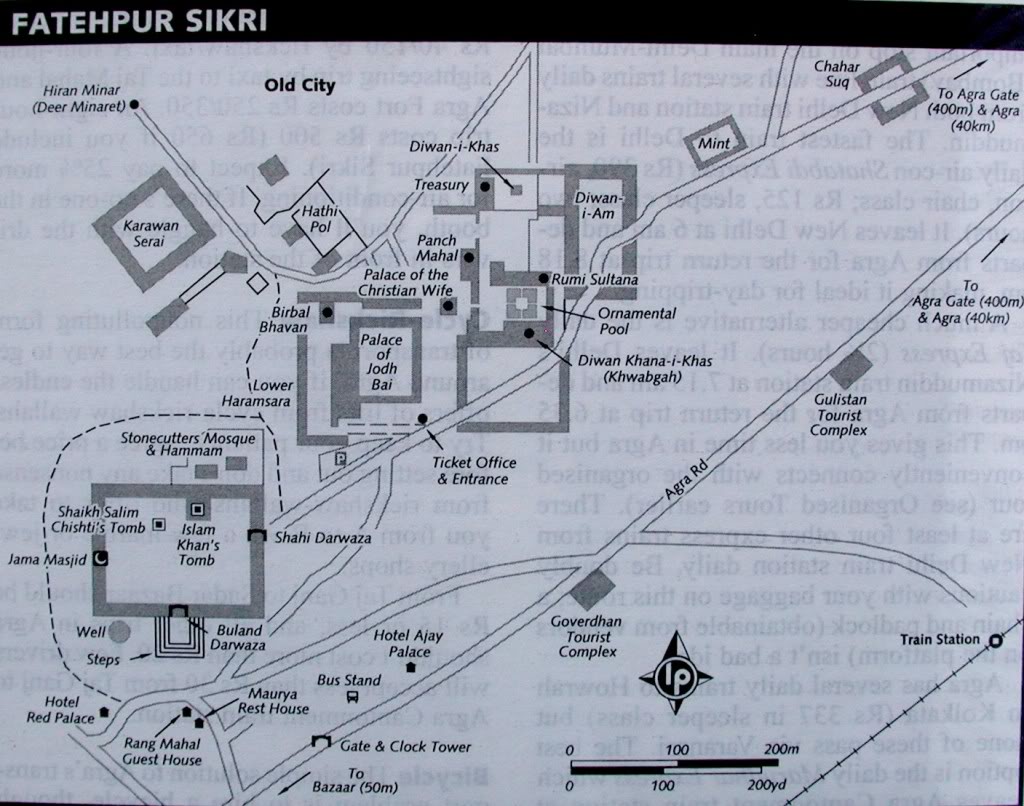
Map of the complex (source Internet)

With the Map given above our journey together of this city will be more easier and interesting. As you can see We moved in from behind the ticket counter and was greeted by this board.

Moving from here towards the Jodhabai Palace


We entered from here and upon coming inside the grand picturesque Red sandstone complex unfolded before us.


Part of Jodhabai Palace


Walking towards the right but further ahead we come across the entrance of Jodhabai  Palace.


Grand entrance of Jodhabai Palace


Jodhabai was also known as Mariam -uz-Zamani. This title was bestowed upon her when she gave birth to Jahangir .Jodhabai's palace is basically a structure built as a house of the principal queen.The outer walls of this fort is 32 feet tall.Entering from this entrance you come to a large courtyard.


Large courtyard at the centre of Jodhabai palace.


This whole palace complex measures around 320 feet by 215 feet consisting of this large central courtyard with buildings arranged around its periphery.One can also find lots of influence of Hindu architecture especially when you note the pillars,niches or brackets.


Influence of Hindu Temple architecture 


Another interesting thing that one notice is the application of blue glaze tiles on one of the roof and cupola.


Blue glaze tiles on the roof


Standing at the centre of the courtyard of this Palace I relived the history. Thinking how the queen lived, It is believed that she was politically involved in the administration through out her life until Noorjahan became empress. It was now time for me to move out of this palace to another part of the Fatehpur Sikri Complex and see what more it has to offer me. Till the time you absorb this historical journey soon I'll join you with the next part of Fatehpur series till then happy reading. 

Link to Fatehpur Sikri Part 2 fatehpur-sikri-series-part-2 DIWAAN-E-KHAAS


Thank You


Popular Posts