Followers

Total Pageviews

Sunday, December 16, 2018

Afghan Church | Churches Of Mumbai Series


Afghan Church, What kind of name is it ?

Never in my wildest dreams I could have associated AFGHAN(Islamic Country) with CHURCH .

Kishe ne sach hi kaha hai ki Bade bade shahero me choti choti baate ho jati hai ðŸ˜œ

I was really intrigued by this weird combination which in turned fired up many more question in my mind.

Could it be possible fusion of Islamic and western culture something like Champaner near Vadodadra Where we saw  amazing architectural influence of Islamic and Hindu culture together in form of Mosques and Chatris or Cenotaphs.

Ab jab sawaal man me utha hai tho uska jawaab bhi toh dondna padega na. 

I had to find an answer to my question on Afghan Church and in order to do so ek visit toh banta hai boss and hence I did my preliminary research on google and set out for my weekend wanderings of this week


Afghan Church:One look and I realised how wrong I was because there was no Afghan but only church. That too angalic church which had a huge spire. So now the question arise why the name Afghan Church. If you hear the tragic tale behind the name it would bring tears to your eyes.


History: Afghan Church was built by British to commemorate  the dead of the first Afghan war and the disastrous 1842  retreat of Kabul also known as Massacre of Elphinstone's army .

This massacre was so brutal that more than 4500 troops of british army was lost along with the 12000 civilians. Despite agreement on the settlement of safe passage to the british troops, this massacre still happened as the Afghan tribals killed most of the retreating soldiers.Many people died because of frostbites and starvation.

The killing was so profound that out of the 16000 people from the coloum commanded by the Elphintone only one European and few Indians sepoys reached Jalalabad. The hardship encountered was such that around 2000 Indians many of known was maimed by the frostbite, survived and returned to Kabul to exist, by begging or were sold to slave trade.  

Our Journey:

We had just finished visiting Haji Ali Dargah and walked back to Mumbai Central Station from where we took local train to Churchgate station. Right outside the station there is a bus stop from where we took local BEST bus no 137 and got down at the Afghan Church stop. Just opposite the bus stop you see a tall spire nestled among the trees. 


Tall Spire of Afghan church
nestle among the ancient trees
The Tall spire of the church can be seen from long distance. The construction and architecture of this church is pioneer in the sense that it paved the way for the high Victorian building that later became the hallmark of British Colonial architecture.


High Victorian style architecture 

I was very excited to explore this church.Imagine staying in Mumbai for more than 50 years and yet I haven't seen this place, well that's the tale of almost many mumbaikar that we are unaware of such hidden treasures within our city.


Yes I am excited to explore Afghan church

I was told that in olden days lots of British Soldiers used to come in this church to attend the Sunday Mass.

We crossed the road and entered the church complex, the lovely Banyan tree on the right of the church welcomed us and we saw few small children enjoying the swing on the hanging branches of the tree. I wanted to click them but they became conscious and ran away.

We then moved on to the main door of the church, which was unfortunately closed. I was very disappointed and after travelling so far I have to go empty handed.


Closed Door !  Will I be going empty handed ?
Kahte hai na... jaha chah hai waha raha hai meaning where there is will there is a way !

Luckily for  us, as we were clicking the exterior of the church, A batch of foreigners came at that time to visit this church. The guide along them went to the caretaker of the church, who stays next to the church. The caretaker came and opened up the Church for us with a rider that We must finish out visit in 10 minutes. We were ushered inside the church from the side door.


Side door through which we entered

I quickly entered the church and I was quite impressed with what I saw. The wide Gothic arches and the colourful stained glass windows coupled with the pin drop silence of the church took my breath away.


The Gothic Arches

Sitting at the church for hardly few moments I could feel the British era atmosphere all around me. I could see the Priest at the Lectern in his majestic robes and I could see the smartly dressed soldier with their wives sitting on the benches of the church listening to the Sunday sermon in my mind's eye. This is the magic of visiting such ancient places.


Can you see the priest...Well I saw !


The colourful stained glasses seems to narrate various episodes of bible I assumed. The light filtering in through these glasses seems to have hypnotic effect on me. It was difficult for me to take away my gaze from them.


Colourful Stained Glasses

Then there are commemorative plaques something similiar to the ones we saw at  St Thomas Cathedral  in this church too that speaks poignantly of the Officers, NCOs and privates and their families who  perished due to war and sickness during the troops withdrawal from Kabul through the snow bound passes. The Dead included both British and Indian soldiers. 


Daylight filtering through this colourful maze
The tiles of the floor were brought from England. The main corridor or Chancel as they call is 50 feet long and 27 feet wide and the huge spire that we see is 198 feet high.


50 Feet long chancel


 I was dazed as I came out the church. I decided to again went to the main door of the church. The beautiful door and the lobby outside it was decorated with colourful red flowers, being christmas time the aura of churches are of different league.


Decorated Church Entrance Door

This church is actually the Church of St John the Evangelist however it is popular known as Afghan Church.Talking about the construction of this church, the imposing edifice were constructed using the locally available buff coloured basalt and limestone.

Buff coloured basalt and limestone.


The church was opened to the public during the year 1858 by the Bishop of Bombay John Harding.


We spent some time exploring the outer side of the Church, took some photographs and bid our goodbye.

Information you can use:


How To Reach
The church is very near to the Colaba Causeway which is between Colaba and Old Woman’s island. One can easily reach here by taking a cab from anywhere in the city.

By Air:
  • Nearest Airport: Mumbai Airport is the closest airport to the church. Airport is 27 km away from the church.
By Road:
  • Nearest Bus Stop: You can catch BEST Bus number 123 from Churchgate station to reach the church.
  • Taxis are available outside the Churchgate and CST station and you can reach in 15-20 minutes
By Rail :
  • Nearest Railway Station: 
  • Chhatrapati Shivaji Terminus on Central Railway is the convenient railway station (6.5 km away) to reach Afghan church Mumbai.
  • Churchgate station on Western Railway is another option which is 3.5 km away.


Saturday, December 15, 2018

Haji Ali | Mumbai Darshan Series


Its now over 50 years that I have been staying in Mumbai. The financial capital of  India but yet within this financial capital there are some real gems of historical delight, architectural elegance and so many other facets that this city hides in its womb. Through this Mumbai Darshan Series, I intend to uncover some famous and some lesser explored places and structures of Mumbai.This is my humble contribution to my city hope you guys like it.


My first place of visit would be Haji Ali Dargah. Millions of mumbaikar pass along this famous Mosque but not many may have actually visited it. In my entire life span of more than 50 years I had visited it once only!


In  the hustle and bustle of the Mumbai city the Haji Ali Dargah is a mosque/Dargah located on an islet off the coast of Worli in the southern part of Mumbai. The Dargah contains the tomb of Sayed Peer Haji Ali Shah Bukhari.


The Haji Ali Dargah was constructed in 1431. in memory of a wealthy Muslim merchant, Sayyed Peer Haji Ali Shah Bukhari, who gave up all his worldly possessions before making a pilgrimage to Mecca. Hailing from Bukhara, in present-day Uzbekistan, Bukhari travelled around the world in the early to mid 15th century, and eventually settled in present-day Mumbai.


Story behind this Dargah:

Stories excites me to no end and I was sure that there would legend or tale or Rivayat as they say about this Haji Ali Dargah. It is learnt from "Rivayat" (Legends) that Pir Haji Ali Shah Bukhari (R.A.) was sitting at some lonely place in his hometown and was busy in his prayers when a lady passed-by from there crying and screaming. When the Saint 
 enquired about her crying, she pointed to an empty vessel 
in her hand and said that she had dropped some oil. And if she goes home without the oil her husband would beat her. She was crying in need of help. The Saint asked her to be calm and went with her to the place where the oil had been dropped. He then took the vessel from the wailing lady and pushed the earth with his thumb. The oil came out like a fountain and the vessel was full. The Saint gave her the vessel with oil and she went away happily.


However, after that, the Saint was troubled by dreams of having wounded the earth by striking it in this manner. Full of remorse and grief from that day he became very serious and was not keeping well. Then with the permission of his mother he traveled to India with his brother and finally reached the shores of Mumbai – near Worli or at some
 place opposite the present tomb. His brother went back to their native place. Pir Haji Ali Shah Bukhari sent a letter with him to their mother informing her that he was keeping good health and that he had decided to reside at that place permanently for the spread of Islam and that she should forgive him. 


Till his death he was praying and giving knowledge about Islam to the people and devotees regularly visiting him. Before his death he has advised his followers that they should not bury Him at any proper place or graveyard and should drop his shroud ('kafan') in the ocean such that it should be buried by the people where it is found.

His wish was obeyed by his followers. That is why the Dargah Sharief is built at the very site where his shroud came to rest in the middle of the sea where it was perched  on a small mound of rocks rising above the sea. The Tomb and Dargah Sharief were built in the years to come.( Source : www.hajialidargah.in ). 


Pathway to the Dargah


As the mosque is located around 500 metres away from the mainland one has to walk down the narrow pathway from the mahalaxmi side to the mosque. This causeway is around one Few metres long. Hence the accessibility to the mosque is very dependent on the tides because the causeway is not bound with any railings, thus during the high tide time the causeway get submerged in the sea water and the way becomes inaccessible to the devotees. 

Walking down this causeway is one of the highlight of visiting this mosque and as you walk you see local made decorative pieces and souvenirs  


Vendors selling souvenirs 

Let us now enter the mosque and see what hidden delights are in store for us. after walking on the causeway we reach the entrance of the mosque which has this huge entrance gate with marble steps.


As I entered the premises I was stuck with awe with the angelic beauty of the white marble mosque standing in front of me, upon inquiring I was told that this mosque was renovated with the first and second grade of white marble which was transported from from Makrana, Rajasthan. The same place from where the marble for Taj Mahal was brought. 


The Dargah Complex consists of :

Main Dargah Building housing the tomb of Pir Haji AliShah Bukhari

On the left side as we enter the complex is a ground plus 2 floor Sanatorium blocks. 

Sanatorium blocks.


Then there is a Qawal Khana.

A prayer hall for men and women.

Minaret.

Minaret

Let me take you to the main building which houses the tomb of the saint.
As soon as you enter you feel the spiritual presence with a huge chandelier gleaming in golden light and the glittering silver walls around me. I stood there for few minutes, paying my respect to the saint, with the sounds of prayers from Qawal Khana.


Glittering Golden lights
As you come out from the shrine and move towards your left  side you see a large prayer hall or Namaz hall for gents. I was told that on the other side of this hall there is a prayer hall for women folk.

Prayer Hall next to the Tomb
The prayer hall looked so peaceful, the red carpet and the marble arches with beautiful designs embed on the pillars.

Beautiful designs on the marble arches
The windows in this hall looks very beautiful because of zali type carving and they too adds to the ambiance and spiritual atmosphere.

Zali Type windows

Coming out of the prayer hall the strong sea breeze hit you with a pleasure beyond expression. I turn around only to see a beautiful dargah with an equally impressive minaret.

Beautiful Marble Dargah

 White marble inviting you to touch it,feel it and yet you are apprehensive and think "kahi mere haat lagane se yeh maila toh hai ho jayega"  So serene and pure this white marble appears. 
Imposing Minaret
Talking of white marble, As I had mentioned earlier in this blog, I was told that the marble used here is actually Makrana Marble, the same type which was used for constructing Taj Mahal. So in other words you can say Mumbai has its own Taj Mahal. ( I know Taj Mahal is way more beautiful then most of the monuments put together) Lekin Mumbai ki collar tight karne ke liye as they say "Kehne me kya harz hai."

After spending some time admiring the beauty of the Dargah one can spend some time on the black rocks behind the Dargah. The view from there of Mumbai skyline is mesmersing and the lashing waves are music to the ears.


For me Haji Ali hold the place of pride as Mumbai's Taj Mahal, where more than 100000 visitors visit every week.It was now time to bid adieu and look out for another new destination.

You make like this Champaner Series


How to reach:

Rail: Mumbai Central and Mahalaxmi Railway station is the nearest railway station, One needs to get out on the west side of the station and take local taxi or City Bus.The distance from Mumbai central station is approx 3.3kms and from Mahalaxmi station its 2,2 kms.

Road:Many BEST buses ply from different points of the city to Haji Ali daily. you can click on this link to search for the bus information BEST buses route network.

Air: Haji ali is 18,2 kms from the Domestic airport and 18.4kms from International Airport Mumbai.Its almost an hour drive if you are taking a cab.


Sunday, October 7, 2018

Temple Trails | Airavateswara Temple | Day 3


Yesterday we had a great time at Rameshwaram visiting the Rameshwaram Temple, some local temples, then visit to Dr Abdul Kalam memorial and we finished our day by visiting the fabulously beautiful Pamban bridge.
You can click here to read about our journey from the beginning.


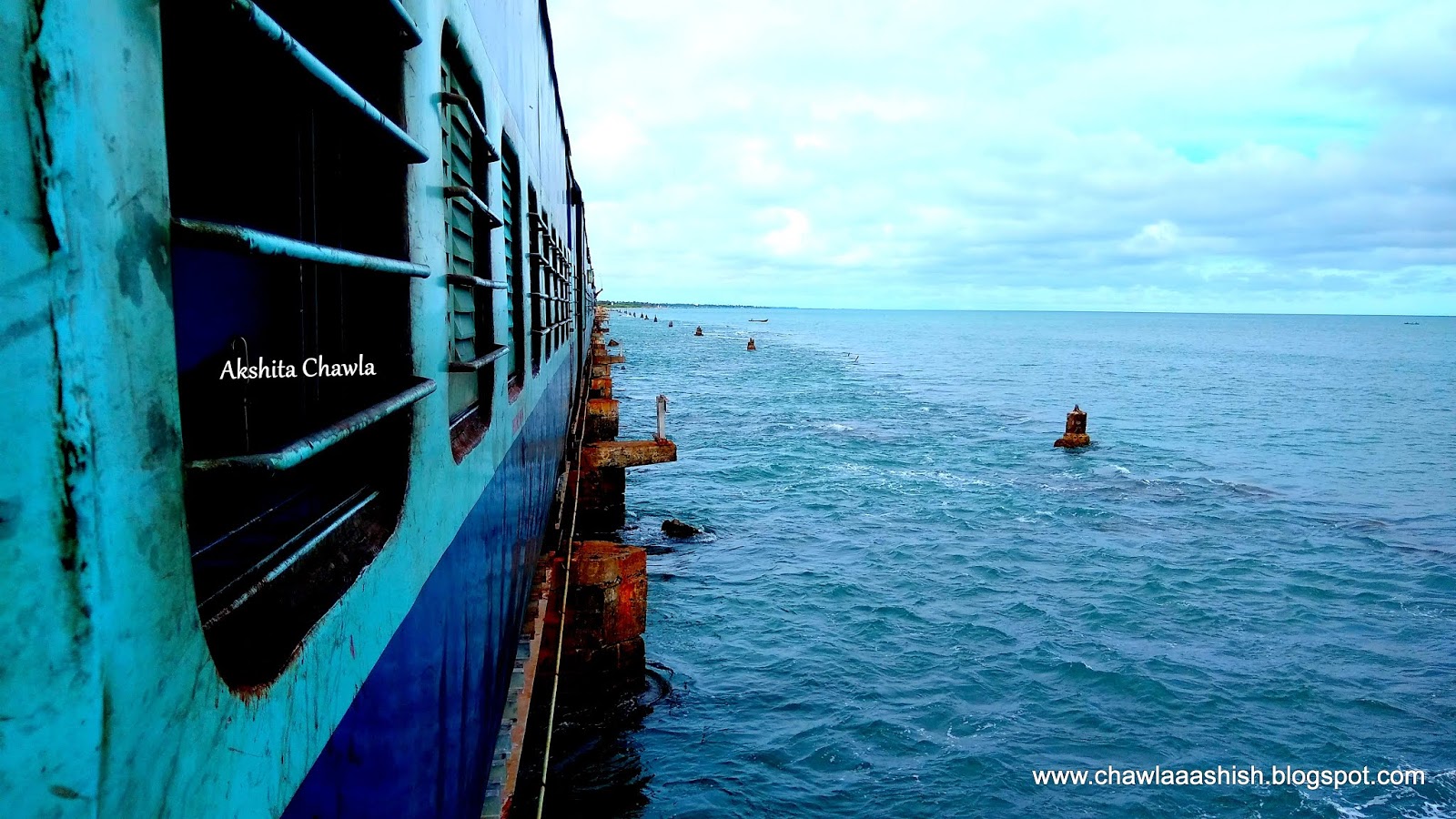
View of the train entering the Pamban Bridge

Sunday,7th Oct 2018

Today we had to catch the train to Thanjavur. So we left our hotel by 8:00 am, took an auto to the  Rameshwaram railway station. Our train was to depart at 8.40.

All excited me ,at Rameshwaram Railway Station

We were all excited because today we will be actually plying over the Pamban bridge. All three of us ie. my wife, my daughter and myself we were ready with our cameras to capture the moment on our mobile phones.bola tha na, pagalpan Puri tarah se humme hai. (other passengers in the train thinking) puri family ka screw dhila hai but apna toh yeah thought WHO CARES !
Yesterday we captured the exterior of the bridge  from the road bridge and today we were going to capture our journey by travelling on it.
This shot from the train itself by my daughter.
The anchored boats were the testimony to the alert call of cyclone and here I was traveling on this railway bridge despite the cyclone warning alert. 

Chakka Jam or Boat Jam....
Yeah nazaara Cyclone Alert ke kaaran


Anyway there was no cyclone, so no adventure to write about, but the sights were amazing. Luckily for us,  today the whole train was almost empty.  Apne baap ki train hai wali feeling as rahi thi.. actually we were very tired because last night we had spent long time lazing at the Agni theerthaam and after coming to our room the blasting thunderstorm didn't allow us to sleep peacefully. 


My favourite window seat and beauty of the nature
Wah kya Jodi Hamaari !

My wife and my daughter immediately went to sleep and I took guard at my favourite window seat clicking pictures and after sometime with the gentle breeze hitting me I too went into a deep slumber.
It was the jerk which opened my eyes and I saw our train leaving some platform behind, I checked out to see which station and was flabbergast to see that we were moving out of Thanjavur station. 

"Zindagi me kabhi train ki chain khichi nahi aur aaj bhi himmat nahi Hui." 

Yeah scene dimag me aate hi chain pulling the idea out !

I jerked my daughter and wife too from their sleep and explained the situation. Saala first time meri life me mera station nikal gaya.

"Logo ki train miss hoti hai 
  aur idhar mera station miss ho gaya 😜😜😜"


"Logo ki train miss hoti hai aur idhar,
 mera station miss ho gaya"

My mind started to work rapidly, my first priority was to check the next station which incidentally was Kumbakonam and the time of the train to Thanjavur. It was hugely disappointing to note that the return train was late in the evening.Next I googled if there are any place which I can visit at Kumbakonam.

Toofani toh har koi karta hai,
Kyo na aaj kuch alag kiya jaye...


Ghummakad hu, pani me dakaa doge. 

toh machali pakad kar bahar aajaunga 😜😜😜


After one hour the next station came ie. Kumbakonam (shayad isliye kumbakaram  ki tarah hum sab soye rahe)


Coming out of the station we saw an auto guy and we hired him to take us to Airavateswara Temple .


Airavateswara Temple


Why you must visit Airavateshwara Temple,
when in Kumbakonnam 

1.The biggest reason to visit Airavateswara temple is, that it is a UNESCO world heritage site,so naturally I was excited all the more. I felt I was destined to visit this temple perhaps that's the reason I must have overslept.

Architectural Delight

2.The Cholas built hundreds of Hindu temples across their empire. Of these four were vast complexes with all stone vimanas. The Airavatesvara temple is one of these four. The other three are the temples found in Thanjavur built by Rajaraja I, in Gangaikonda Cholapuram built by Rajendra I, and in Tribuvanam by the later era Chola king Kulottunga II. Hence Airavateshwara Temple is one of the living Chola Temple.

Intricate carvings

3.The intricate carvings and statues in this temple are class apart.

4.The peaceful ambiance, the musical stairs are something unique to be seen in this temple. 

Peaceful ambiance

5.To a photographer Airavateswara Temple offers some magnificent shots and angles.

Good Photo angles

6. 100 pillars hall with intricate carving on each of them.

Pillars with Yali sculptures


7. There are many unique sculptures in the temple and one of that include a 73 panel of sculptures depicting the life history of 63 Nayanmars.
"Nowhere one can see in such details the life history of Nayanmars.

8. Last but not the least its one of the Great living Chola Temple.


History:

The temple was built by king Rajaraja Chola II who ruled the Chola Empire between 1146 and 1172 CE. The Airavatesvara temple was much larger than what we see today. According to the inscriptions. It had sapta veedhis (seven streets) and seven courts, similar to the Srirangam temple. However nothing remains today, except the one court with the main temple which survived.There are ruins of gopuram and some structures at some distance from the current visitor premises confirming that the site was badly damaged at some point like the other major Chola era temples and various Chola cities including the capital Gangaikonda Cholapuram.


Legends:

This temple is dedicated to Lord Shiva. As per mythology, Lord Shiva was worshiped here by Airavata, Lord Indra's elephant who had seven trunks and four tusks. After being cursed by sage Durvasa for not respecting him, the spotless Airavata turned into a discoloured elephant.Inorder to be free from this curse the elephant took a dip in the sacred waters of this temple.

There there is another legend according to which it was believed that Yama, the King of Death, also worshiped Lord Shiva here. Yama, who was cursed by a sage which caused a burning sensation all over his body, took a dip in the sacred tank of the temple and got cured. This temple tank is thus named Yamateertham.


Tales of Pandavas Rage or Delhi Sultanates Plundering

The reasons for the destructions of Chola temples are unclear. According to Vasanthi, the Pandavas who defeated the Cholas during the later part of 13th century "may have raged the Gangaikonda Cholapuram to ground" to avenge their previous defeats. However, it is unclear why other temples were destroyed and this temple was spared, as well as why there are around 20 inscriptions from later Cholas, Pandyas and Vijayanagar Empire indicating various gifts and grants to this temple.


An alternate theory links the destruction to the raids, plunder and wars, particularly with the invasion of the capital city and the territories that were earlier a part by the Chola Empire along with Madurai by the armies of Delhi Sultanate led by the Muslim commander Malik Kafur in 1311, followed by Khusrau Khan in 1314 and Muhammad bin Tughlaq in 1327. The period that followed saw wars between the Hindu kings and the Muslim Sultans who seceded the Delhi Sultanate and carved out new polity such as the nearby Madurai Sultanate (1335–1378). The Vijayanagara Empire defeated the Madurai Sultanate in 1378 and this temple along with other Chola era temples thereafter came under Hindu kings again who repaired and restored many of them.


Our journey :

In 15 -20 minutes we reached the Airavateswara temple, What took us by surprise was the well maintained garden outside the temple complex. Crossing the garden we come across the main gate of the temple but not before noticing the Nandi in front of the gate. A huge Black stone Nandi. We were told that this Nandi mandapa is aligned with the main temple's east west axis. 


Huge Black stone Nandi outside the main entrance.


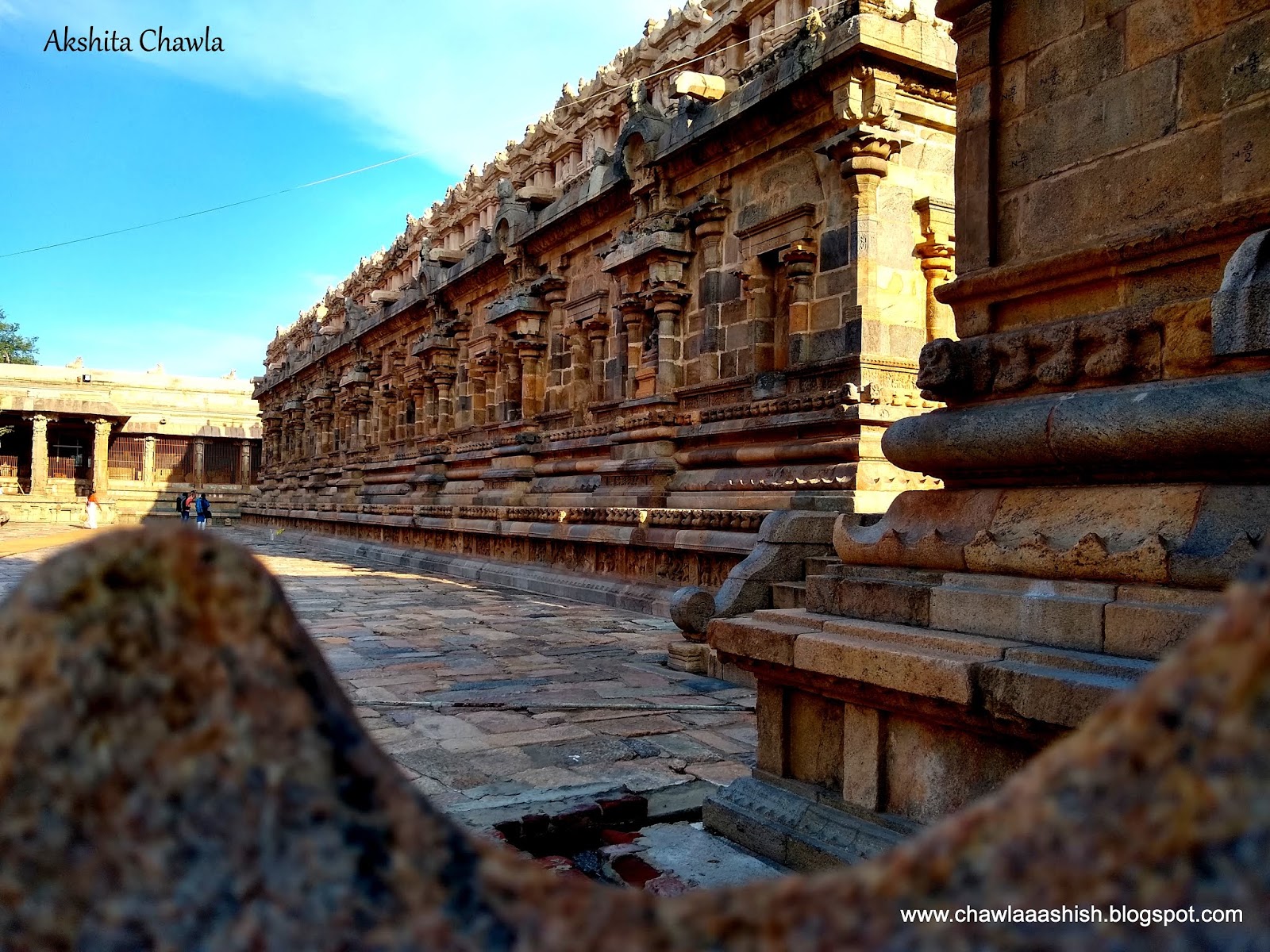
After clicking few pictures of the huge black stone Nandi we entered the main complex of the temple. Just like the other temples of the South India this too was enclosed within huge walls.

The first hall that you see as you enter the complex has 100 pillars and each pillar has stone carving depicting scenes of olden days. I couldn't find any guide so I was unable to comprehend much. 

100 Pillars Hall

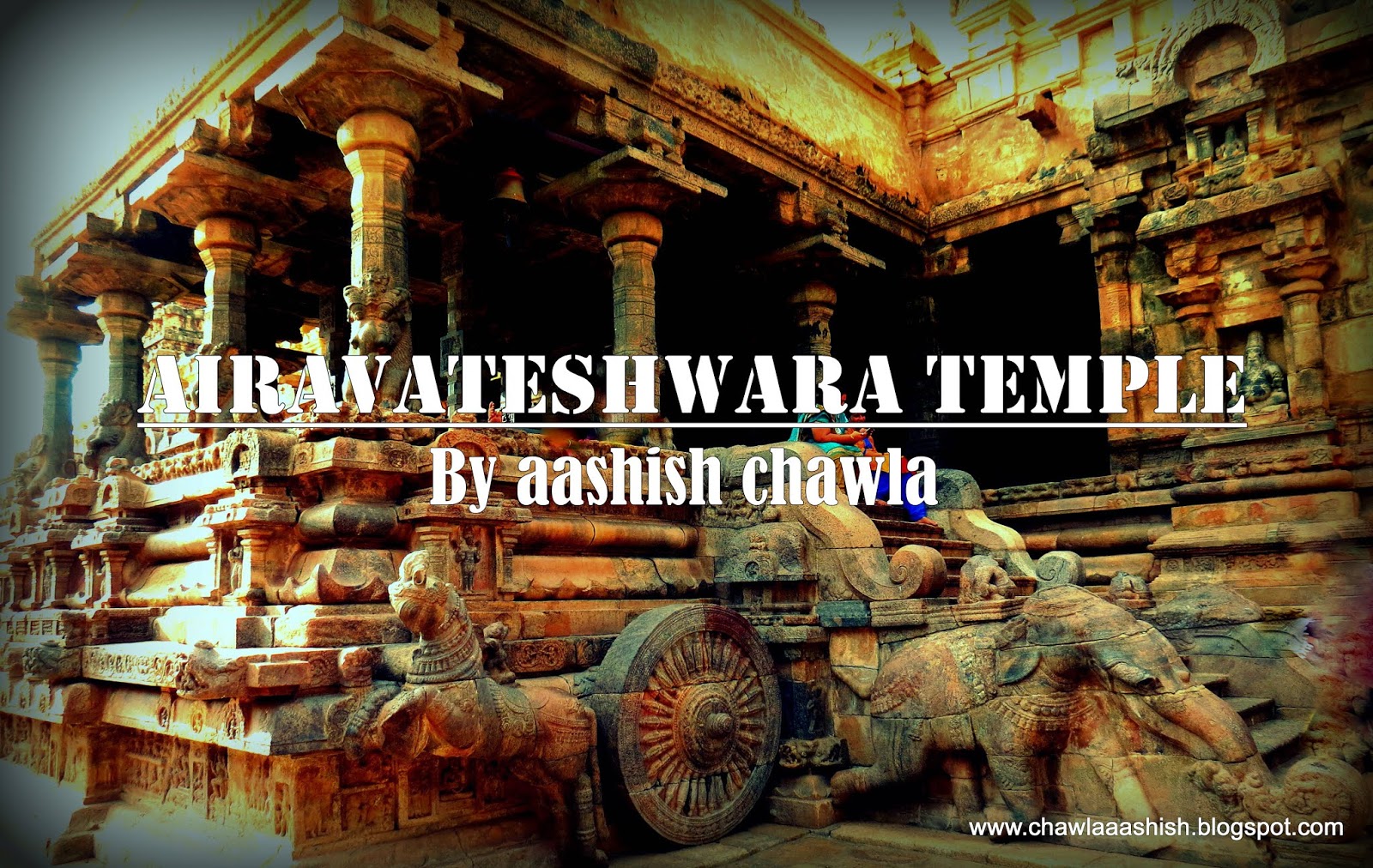
The most unique feature of the temple was the horses at the entrance steps. The front Mandapa known as Rajagambhiran Tirumandapam is unique as it was conceptualized as chariots with wheels. 


Elephants, Horses and Chariots 


Next we come across a strange sculpture of fusion of Elephant, horse or was is something else ?

Is it an elephant or  a horse ?
moving on to the back side of the temple there is this beautiful Shiva Sculpture in black stone.

Shiva Sculpture at the back of the temple

Considering that I am no historian nor I am deeply in architecture, Its quite possible that I may fall short of providing all the information on this temple. In case if you are willing to dig deep I found this website quite useful you can click here to read more.  


We spent quite sometime here and were simply overwhelmed by the beauty of this temple. The sun was on the verge of setting so we were rushing back to catch out bus to Thanjavur, where the Big Temple alias Brihadeeshwara Temple awaits us. 

How to reach:

Air: Nearest Airport is Trichy Airport, One can take a cab,bus or train to reach here.

Rail: Darusuram is the nearest railway station.However only passenger trains stop here. If you take express train then one needs to get down at Kumbakunam railway station.

Bus: There are regular buses from Trichy,Madurai,Thanjavur .
I was told that there are regular mini buses from Kumbakunam Railway station every 15 minutes plying to the temple. 


Thanks for reading the blog and in case if you are interested in reading the story from the beginning please click here on the link here.


Popular Posts